
How to Read a Paycheck: A Section-by-Section Guide
Maybe it is your first summer-job paycheck or maybe you have been getting paid for years and you want to start taking a closer look at your pay stub. If you have ever glanced at your pay stub and wondered what each line means, and why money is being taken out of your paycheck, this guide is for you.
That gap between what you earned and what you actually take home is normal, and once you understand your pay stub, it can help you plan for the money that will actually end up in your bank account.
For families, it is also a natural next step after the money habits you build when kids are younger. A first summer job is where those lessons meet real dollars, and it makes a great moment to read a pay stub together.
Let's read a real pay stub together
Let’s follow one sample pay stub the whole way through. Meet Jordan, who works part-time at a cafe. Last pay period, Jordan worked 20 hours at $15.00 an hour. Here is what shows up on the stub (you can follow along with our sample pay stub below).
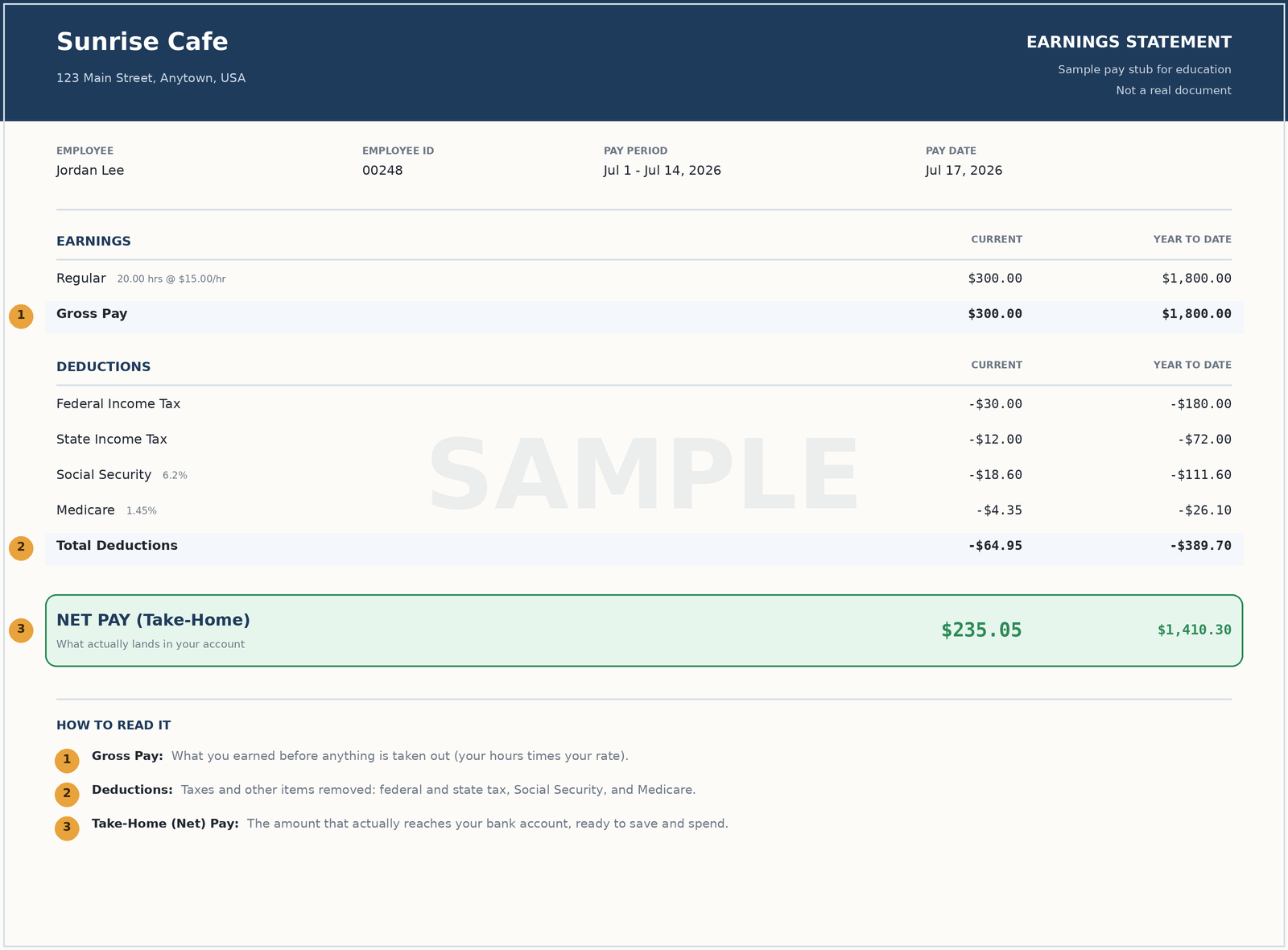
Sample pay stub for educational purposes only.
Who and when
The top of the stub is the identifying information: your employer’s name, your name and employee ID, the pay period the check covers, and the pay date. It is easy to skim past, but it is worth a glance to confirm the dates are right and the stub is actually yours.
Earnings: your hours, rate, and gross pay
Next comes what you earned. Jordan’s stub lists 20.00 hours at $15.00 an hour. Multiply those together (20.00 × 15) and you get gross pay (#1): the full amount earned before anything is taken out, which is $300.00.
Gross pay is the number people usually have in their head when they think about what they “make.” It is also the starting point for everything else on the stub. Always check that the hours and rate match what you actually worked, because this is your money and mistakes do happen.
Deductions: what comes out, and why
Here is the part that explains the gap. Deductions (#2) are the amounts subtracted from your gross pay, and most of them are taxes. On Jordan’s stub, they add up to $64.95. Here is the breakdown:
| Deduction | This paycheck | What it is |
|---|---|---|
| Federal income tax | $30.00 | Based on the Form W-4 filled out at hiring |
| State income tax | $12.00 | Depends on your state; some have none |
| Social Security | $18.60 | 6.2% of pay, funds retirement and disability |
| Medicare | $4.35 | 1.45% of pay, funds health coverage for people 65 and older |
| Total deductions | $64.95 | Subtracted from gross pay |
Social Security (6.2%) and Medicare (1.45%) are shown at current 2026 rates. These rates are set by law and could change in future years.
A few things worth knowing: federal income tax depends on the Form W-4 you filled out when hired, and depending on what you earn over the course of the year, you may get some of it back when you file a tax return. State income tax varies, and a few states have none. Social Security and Medicare are grouped together as FICA and apply to almost every worker. On future jobs you might also see deductions for a retirement plan or health insurance, which are money set aside for you rather than taxes.
Net pay: what ends up in your bank account
Subtract the deductions from gross pay and you get net pay (#3), also called take-home pay. For Jordan, $300.00 minus $64.95 comes to $235.05. This is the number that actually lands in the bank account, and the one to build your plans around. When you know your real take-home, budgeting stops being guesswork.
Year-to-date totals
Finally, most stubs show year-to-date (YTD) figures: running totals of what you have earned and paid so far this year. Jordan has earned $1,800.00 gross and taken home $1,410.30 year to date. These totals are handy for tracking your income and are helpful at tax time.
A quick check every pay period:
Multiply your hours by your rate. For Jordan, 20 times $15.00 is $300.00. Does it match the gross pay on the stub? It does.
Scan the deductions. Do they look about the same as last time?
Look at your take-home. That is what you actually have to work with.
If something looks off, ask your manager or the person who handles payroll. It is your money, and you have every right to understand it.

