
Understanding the Three Types of Savings
Not all savings goals work the same way, and treating them like they do is one of the most common reasons saving feels like it's never enough. An emergency fund, short-term savings, and long-term savings each protect a different part of your financial life, and each one calls for its own plan and its own account. The fix isn't saving more, it's saving with more clarity: one fund ready for whatever life throws at you (emergency), one set aside for a goal you can already see coming (short-term), and one growing quietly toward the future you're building (long-term).
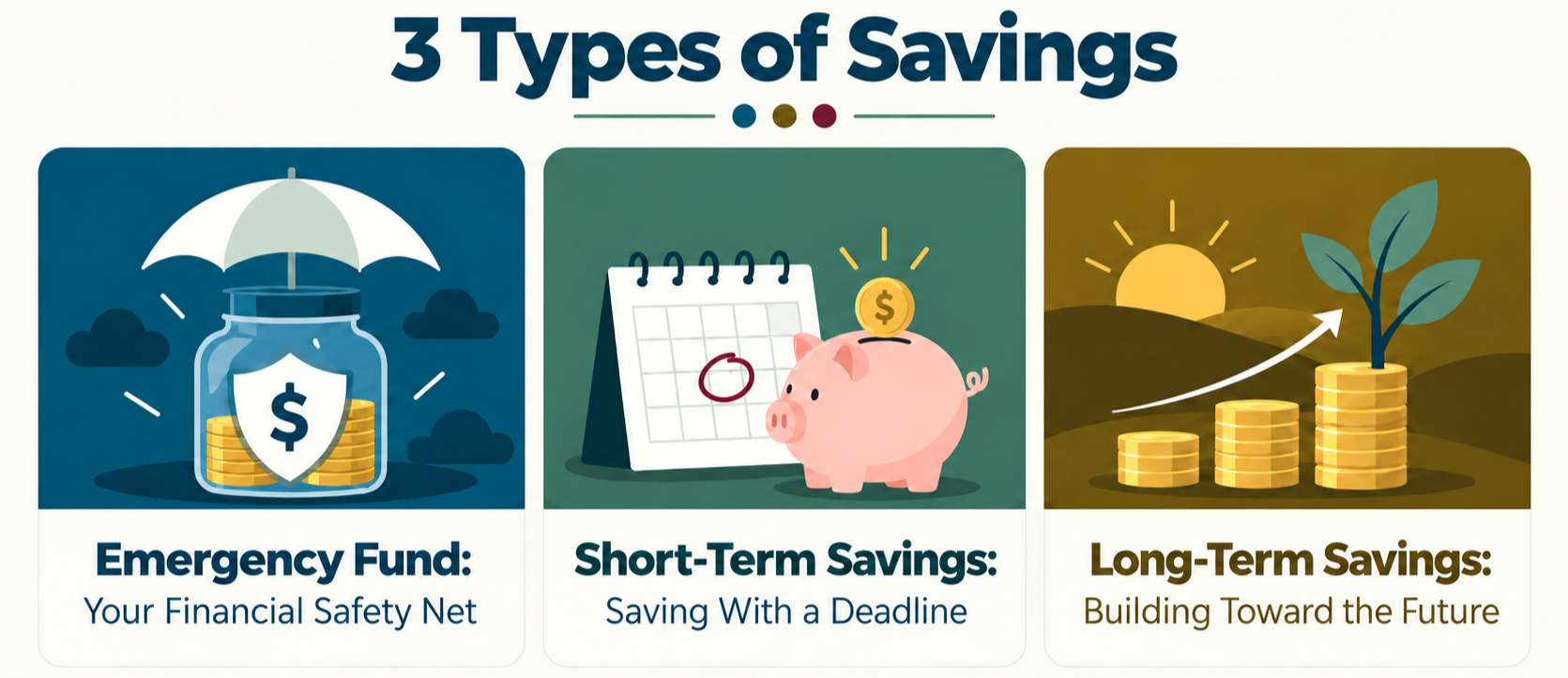
Emergency Fund: Your Financial Safety Net
An emergency fund is the money you can reach fast when life throws something at you. "Fast" is the key word: it needs to be liquid, meaning cash on hand or money sitting in a checking or savings account, not tied up in a car, a home, or an investment that takes time (and sometimes a loss) to convert into cash.
How much is enough depends on your situation. A common starting target is three to six months of essential expenses: housing, utilities, food, insurance, transportation, minimum debt payments. If your income is variable, your job is in an industry prone to layoffs, or you are the sole earner in your household, lean toward the higher end of the 3–6-month range or beyond it. If you have a stable dual income household or strong unemployment coverage through your industry, the lower end may be realistic.
Think of the number less as a rule and more as a cushion. You want to have enough breathing room that a job loss or a big, unplanned expense doesn't turn into a crisis.
When it makes sense to use it
Sudden job loss, to cover essential bills while you search for the next opportunity
Losing something you need to earn income, like a work vehicle or a computer you rely on for your job
A medical emergency for you or someone in your household
Damage from a fire, flood, storm, or other disaster, or an insurance deductible tied to one
A repair that will get worse and cost more if you wait, like a leaking roof or a failing furnace
A simple gut check for anything that doesn't obviously fit: was it unexpected, and does it need to be handled soon? If both are true, using your emergency fund is a reasonable call. If either answer is no, it's worth pausing and asking whether a different part of your budget should cover it instead.
Beyond the math, there's a wellbeing piece to this too. Financial stress is one of the most consistent predictors of poor physical and mental health outcomes, so an emergency fund isn't just a savings tactic. It can be a buffer that protects your health along with your finances.
Short-Term Savings: Saving With a Deadline
Short-term savings are for goals you can see on the calendar, generally anywhere from a few months to about three years out. A holiday budget, a car repair you can plan for instead of react to, a security deposit on a new apartment, a wedding, a vacation. Unlike an emergency fund, these dollars already have a job. You're not asking "what if," you're asking "when."
Because the timeline is short, the priority is keeping the money safe and accessible, not chasing growth. A high-yield savings account or a short-term certificate that matures around when you'll need the funds both work well. What you want to avoid is putting short-term savings into anything that can lose value right before you need to spend it.
A useful way to size a short-term goal: take the total cost, divide it by the number of months until you need it, and that's your monthly savings target. A $1,200 vacation nine months out is $133 a month. Naming the number turns a vague goal into a routine transfer.
It's worth keeping short-term goals in their own account, separate from both your emergency fund and your everyday spending money. When everything sits in one account, it's easy to "borrow" from a goal without noticing, and just as easy to lose track of how close you are to reaching it.
Long-Term Savings: Building Toward the Future
Long-term savings are for goals more than three years away, like retirement, a home down payment, or a child's college fund. Because the timeline is long, this money can be invested instead of just held in cash. That gives it time to grow and to recover from market ups and downs.
The tradeoff is access. Long-term savings are usually harder to reach on purpose. Pulling money out early can mean real penalties, like taxes and fees on an early retirement withdrawal. That's not a flaw, it's the point. It keeps this money working toward its goal instead of covering short-term needs. That's also why a separate emergency fund and short-term savings matter: you should never have to raid retirement savings to fix a car.
A few starting points:
Retirement accounts like a 401(k), 403(b), or IRA often come with tax advantages. If your employer offers a match, contribute enough to get the full match first. It's free money.
529 plans offer tax-advantaged growth for education costs. Many states also offer a tax deduction or credit for contributions.
Consistency beats timing. Regular contributions, even small ones, tend to beat trying to guess the best moment to invest.
Long-term savings work best on autopilot. Set up automatic contributions sized to what your budget can sustain over years, not just this month.
Ready to put this into practice? SSA members can access the full Savings Pathway right in the member portal, including the companion worksheet and additional downloadable resources to help you build your emergency, short-term, and long-term savings at your own pace.
