
Understanding Loan Interest: How It Really Adds Up
If you read our loan basics post, you already know what principal, interest and term mean, and how they combine to shape what you owe. This post builds on what you learned by breaking down a part of loans that can feel especially confusing: how interest actually accumulates over time, and why the difference between a flat interest calculation and a compounding one matters.
Flat interest vs. compounding interest
Flat interest (also called simple interest) is calculated once, on the original amount you borrowed, and stays fixed for the life of the loan. It doesn't change based on what's already been paid or what interest has already built up. For example: you borrowed $2,000 at a flat interest rate of 18%. Your interest payment = $2,000 × 18% = $360.
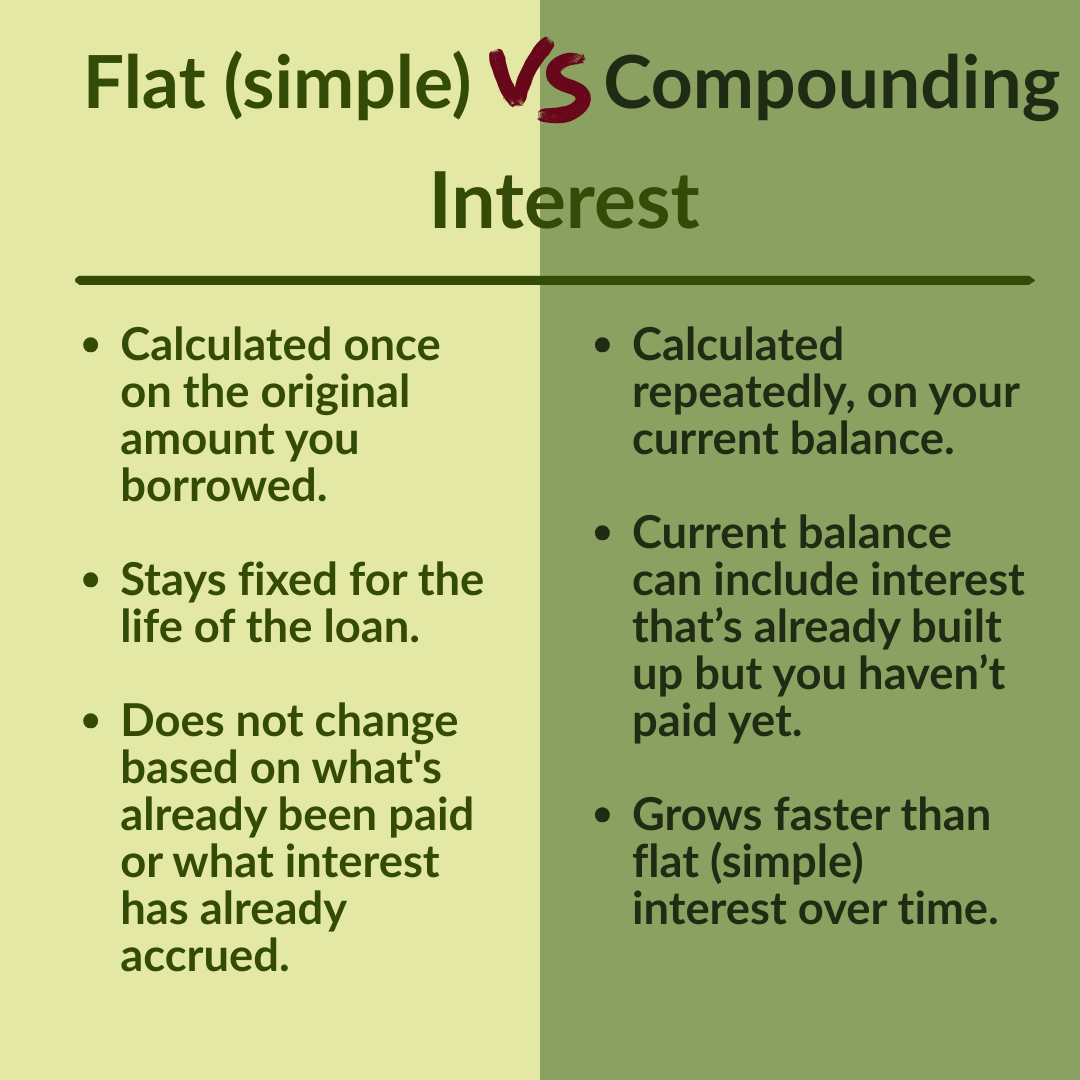
Compounding interest is calculated repeatedly, on your current balance, which can include interest that's already built up but hasn't been paid yet. Once that unpaid interest gets added to your balance, you start being charged interest on interest, which is what makes it grow faster than flat interest over time.
Depending on how your loan is structured, interest can be calculated once and added to your balance, or it can build on itself, month after month, in a way that quietly grows your debt faster than you might expect. Let’s look at the same sample but with compounding interest:
Say you borrowed $2,000 at an 18% annual interest rate to cover a car repair. Your lender let you skip payments for six months but interest kept compounding (adding up) monthly. In month one, you'd owe about $30 in interest. By month two, that unpaid interest is now part of your balance, so you're charged interest on a slightly bigger number, around $30.45 that month. This table below shows how the balance grows month by month:
Compounding interest & no payments for 6 months:
| Month | Interest charged | Balance |
|---|---|---|
| Start | N/A | $2,000.00 |
| 1 | $30.00 | $2,030.00 |
| 2 | $30.45 | $2,060.45 |
| 3 | $30.91 | $2,091.36 |
| 4 | $31.37 | $2,122.73 |
| 5 | $31.84 | $2,154.57 |
| 6 | $32.32 | $2,186.89 |
When you're paying down the loan each month
Now say you take out that same $2,000 loan at 18% annual interest, but instead of skipping payments, you pay $200 a month. In your first payment, $30 goes toward interest, the same $30 as month one above, since it's the same balance and the same rate. But this time, the remaining $170 goes toward principal, bringing your balance down to $1,830. The table below shows payments over the same 6-month time period:
Compounding interest & making a payment each month from the start:
| Payment | Interest charged | Principal paid | Balance |
|---|---|---|---|
| Start | N/A | N/A | $2,000.00 |
| 1 | $30.00 | $170.00 | $1,830.00 |
| 2 | $27.45 | $172.55 | $1,657.45 |
| 3 | $24.86 | $175.14 | $1,482.31 |
| 4 | $22.23 | $177.77 | $1,304.54 |
| 5 | $19.57 | $180.43 | $1,124.11 |
| 6 | $16.86 | $183.14 | $940.97 |
Compare: that same $2,000 loan with no payments would have grown to $2,186.89 after six months. With $200 monthly payments instead, the balance has dropped to $940.97, a difference of more than $1,200. Same starting point, same rate, very different outcome.
Both scenarios start with the exact same $30 interest charge. From there, one balance keeps climbing because nothing is being paid toward it, and the other keeps shrinking because payments are chipping away at principal every month. Each month you pay, more of your payment goes toward principal and less toward interest, which is why early payments on a loan can feel like they're barely making a dent, even though they're doing real work.
This process is called amortization, and it works differently than compounding. There's no interest building on unpaid interest here, just simple interest recalculated each month on a shrinking balance.
Online Tools Can Help
You don't have to do this math by hand. Free amortization calculators, like the one at Investopedia, let you plug in your loan amount, rate, and term to see exactly how your balance will shrink over time and how much of each payment goes toward interest versus principal.
Understanding how this works won't change your rate, but it can change how you use a loan. Paying a little extra toward principal early on, or avoiding no-payment periods that let interest compound, can save you money over the life of a loan.
If the rate you're being offered feels high, it's worth checking your credit report to understand what's shaping it, and it's worth talking to your financial institution directly. They can walk you through how your rate was set and whether there's room to improve it.
Unlock more learning from SSA
SSA members have access to our full learning pathways on credit, loans, and debt. Become a member to unlock all resources.
Become a member